
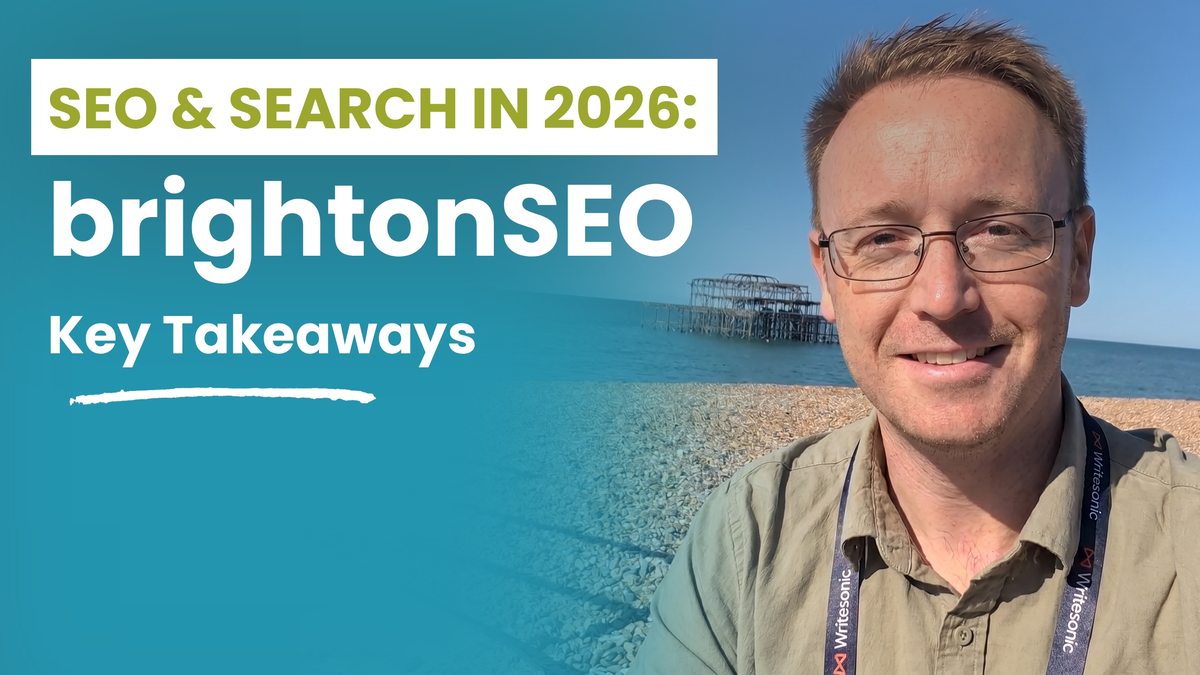
I spent another few days down in Brighton for brightonSEO and HeroConf in April 2026 and, as always, came away with far more notes than I planned.
I always tell myself I will stick to four or five useful points per talk. That lasted about five minutes.
This one felt a little different for me too. After speaking at brightonSEO and MeasureFest back in October about Black Friday, I returned to Brighton this time to speak at HeroConf. You can read more about my Black Friday talk at brightonSEO and MeasureFest if you want the context from that event.
This time, I was there both as a speaker and as someone trying to absorb as much as possible from the wider search and paid media conversations happening across the two days.
Across the sessions I attended, there were some excellent insights on where search is heading, particularly around zero-click search, AI Overviews, paid media, brand discoverability, reporting, trust, stakeholder buy-in, and how commercial value should be explained when the traditional numbers start to look less predictable.
Having worked agency-side in search for more than 17 years, I have seen plenty of industry shifts arrive with big claims attached. Some changed client strategy in meaningful ways. Some created a lot of noise before settling into something more practical. This felt like one of those moments where the change is real, but the response needs to be measured rather than frantic.
There is a fair amount of doom and gloom in the industry at the moment. Organic clicks are under pressure. AI Overviews are changing the shape of informational search. Paid results and product features are pushing organic listings further down the page. More discovery is happening away from the traditional search results page altogether.
But my main takeaway from brightonSEO and HeroConf was not that SEO is dying, or that AI is replacing everything.
It was this:
Search is becoming broader, more fragmented, and more commercially nuanced. The brands that win will be the ones that are visible, trusted, cited, selected, and measured properly across the whole discovery journey.
That has real implications for SEO, paid search, CRO, content, analytics, digital PR, and brand strategy.
Watch the video
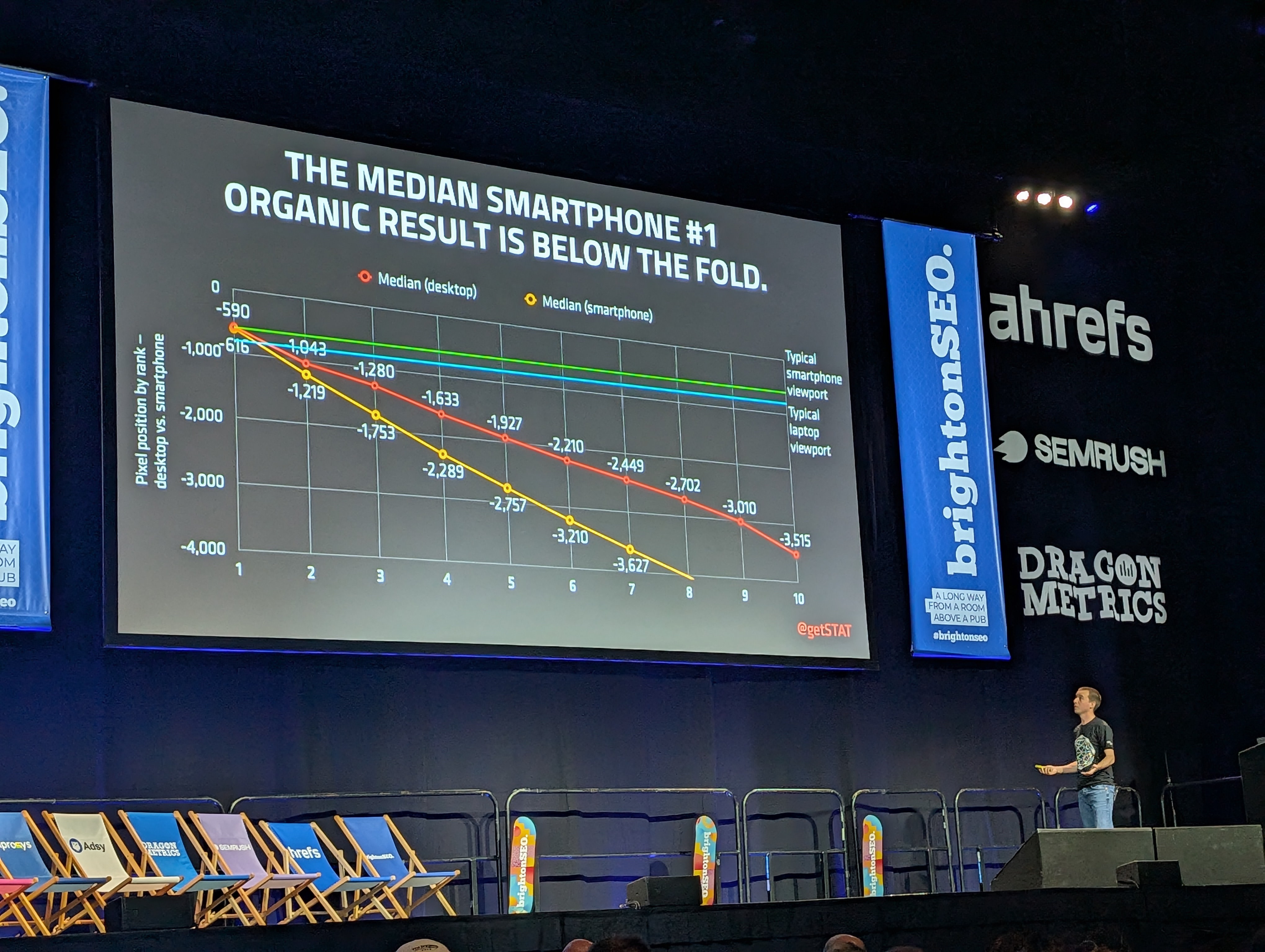
Position 1 is not what it used to be
One of the clearest visual moments came from Tom Capper’s talk, How low can organic go.
The message was simple, but important. Ranking number 1 organically does not necessarily mean being seen first.
Tom talked about “the great scroll” and made the point that rank tracking alone is no longer enough. On mobile in particular, position 1 can often sit out of view. Commercial SERPs are increasingly dominated by paid results, shopping features, product grids, AI Overviews, maps, filters, reviews, and other Google-owned features before traditional organic listings get much attention.
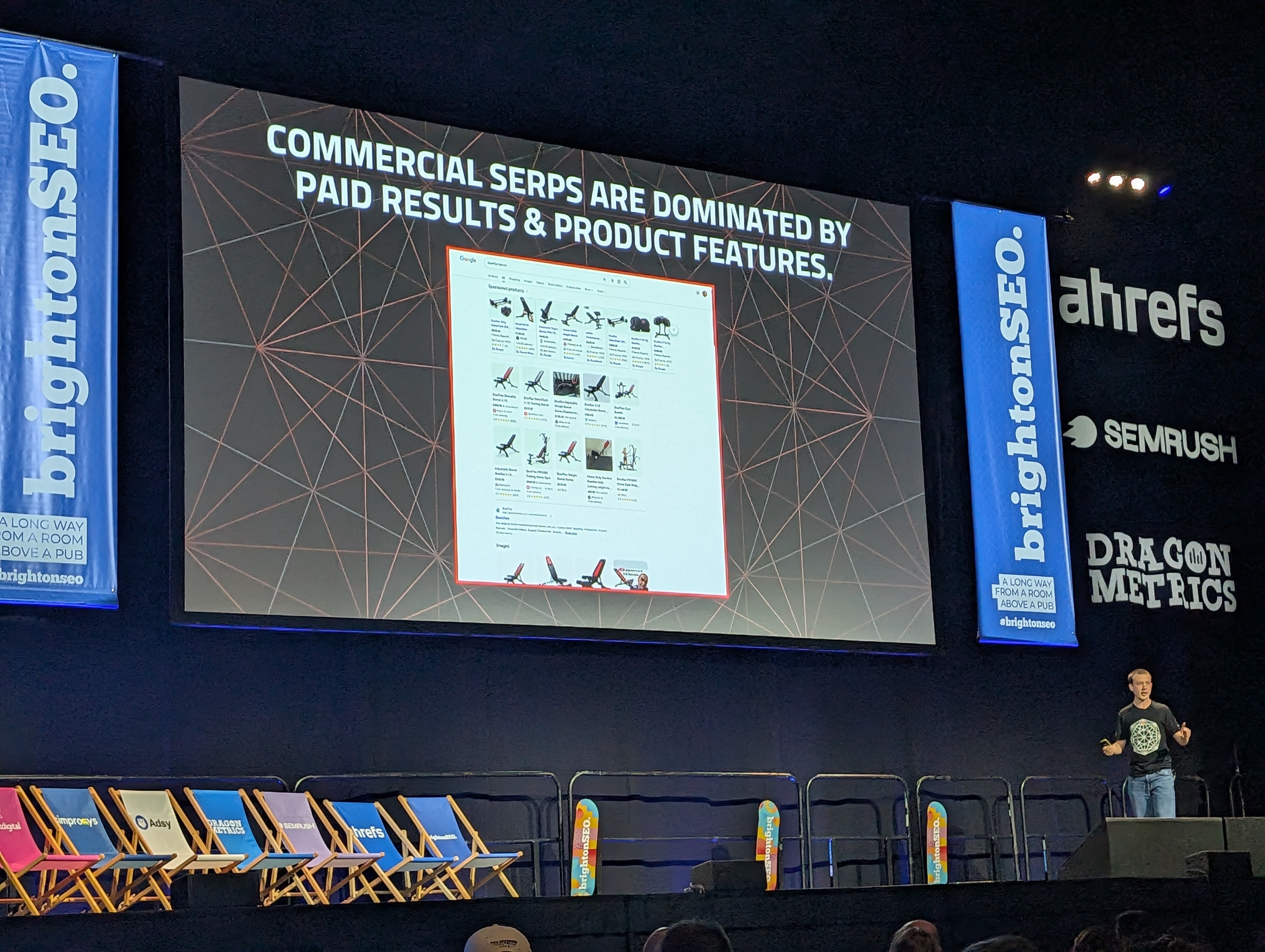
That changes how performance should be judged. I have sat in enough client meetings over the years to know how misleading a clean ranking report can be when it is detached from what people actually see on the results page.
For years, SEO teams have reported on rankings as if all positions are created equal. They are not. Position 1 in one vertical may be highly visible. Position 1 in another may sit underneath a full screen of ads, product listings, filters, AI summaries, and other features.
This is where pixel position becomes a much more useful way of thinking.
Rather than only asking, “Where do I rank?”, the better question is:
How visible is the brand on the actual results page that users see?
That means looking at the shape of the results page by intent, device, market, and vertical. For commercial searches, that may strengthen the case for paid search and feed optimisation. For informational searches, it may mean targeting AI Overviews, featured snippets, video, Reddit, forums, or other cited sources. For local searches, it may mean reviews, map visibility, location pages, and local authority matter more than a traditional blue link.
The practical implication is clear. SEO strategy needs to become more visual, more commercial, and more SERP-specific.
Being on page one is not enough. In some cases, even ranking first is not enough.
Zero-click does not mean zero value
A major theme across both events was zero-click search.
That came through strongly in Jack Lingard’s talk, How to prove SEO works when it no longer drives traffic, and Liv Day’s stakeholder-focused talk, Organic traffic is down. Here’s how to talk about it with senior stakeholders.
There was a lot of discussion about declining organic clicks, AI Overviews, changing user behaviour, and the growing number of journeys where users get what they need without visiting a website.
This can sound worrying if SEO is still being measured mainly by traffic.
But it becomes less alarming when you step back and ask better commercial questions.
If organic traffic is down, is revenue also down?
Are leads down?
Is branded search up?
Is direct traffic increasing?
Are returning users converting better?
Is demand being influenced earlier in the journey, even if attribution is weak?
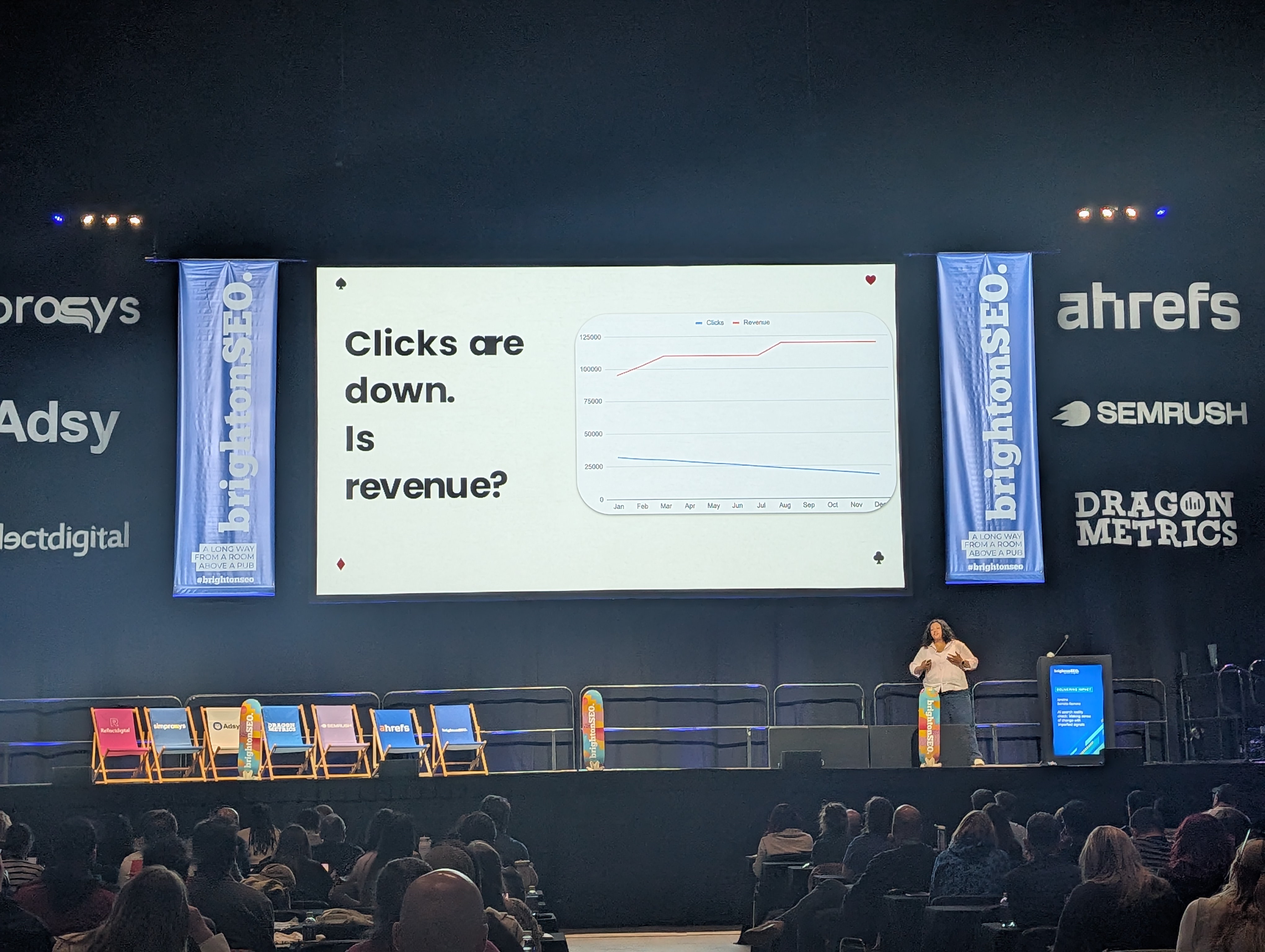
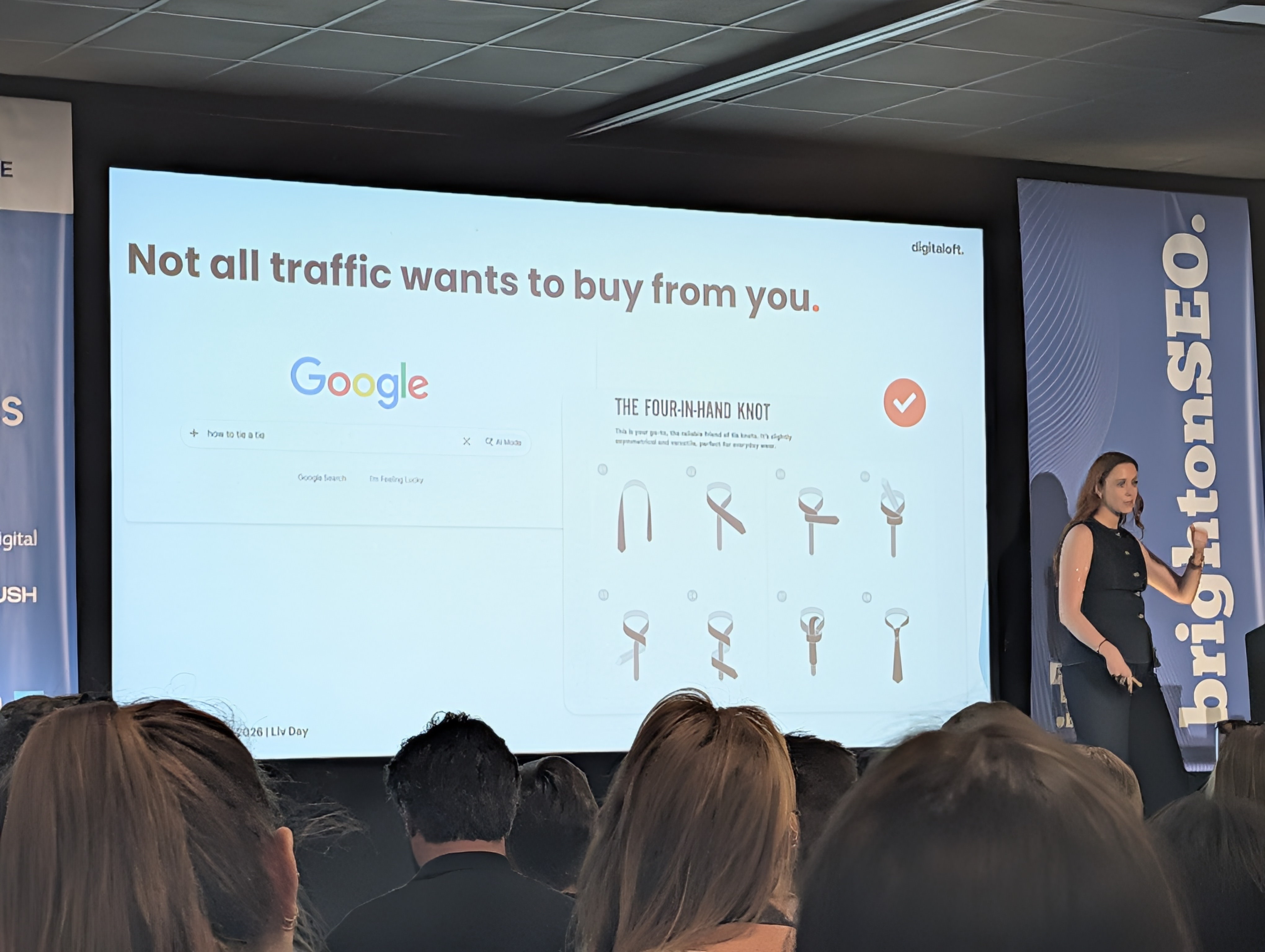
Liv Day’s point that “traffic, on its own, is a vanity metric” is a useful one. Some informational blog traffic may have looked good in a report, but had very limited commercial value. Some of it was never going to become a lead, sale, enquiry, or meaningful customer interaction.
That does not mean traffic no longer matters. It means traffic needs context.
If traffic is falling, the first response should not be panic. It should be diagnosis. That is not always easy when stakeholders are looking at a downward traffic graph, but experience has taught me that the first explanation is rarely the complete one.
Look at it by page. Look at it by search term. Look at the intent behind the lost visits. Then quantify that against leads, enquiries, revenue, assisted conversions, and conversion rate.
The question is not just, “Did traffic fall?”
The better question is:
Did the business lose traffic that had commercial value?
Jack Lingard’s Search Influence Framework also stood out here because it pushed measurement beyond last-click traffic. Search influence now often happens before the click, around the click, and sometimes without a click at all.
That means reporting needs to get closer to signals such as branded search demand, assisted conversions, returning user behaviour, direct traffic growth, share of search, AI visibility and citations, lead quality, and revenue impact by landing page or query theme.
The key point is that SEO is not becoming less valuable. It is becoming harder to measure using old reporting models.
That is a problem, but it is also an opportunity for search teams that can connect visibility to commercial outcomes more clearly.
AI search rewards strong fundamentals, not shortcuts
There were plenty of AI search talks across the two days, and not all the findings were neat or predictable.
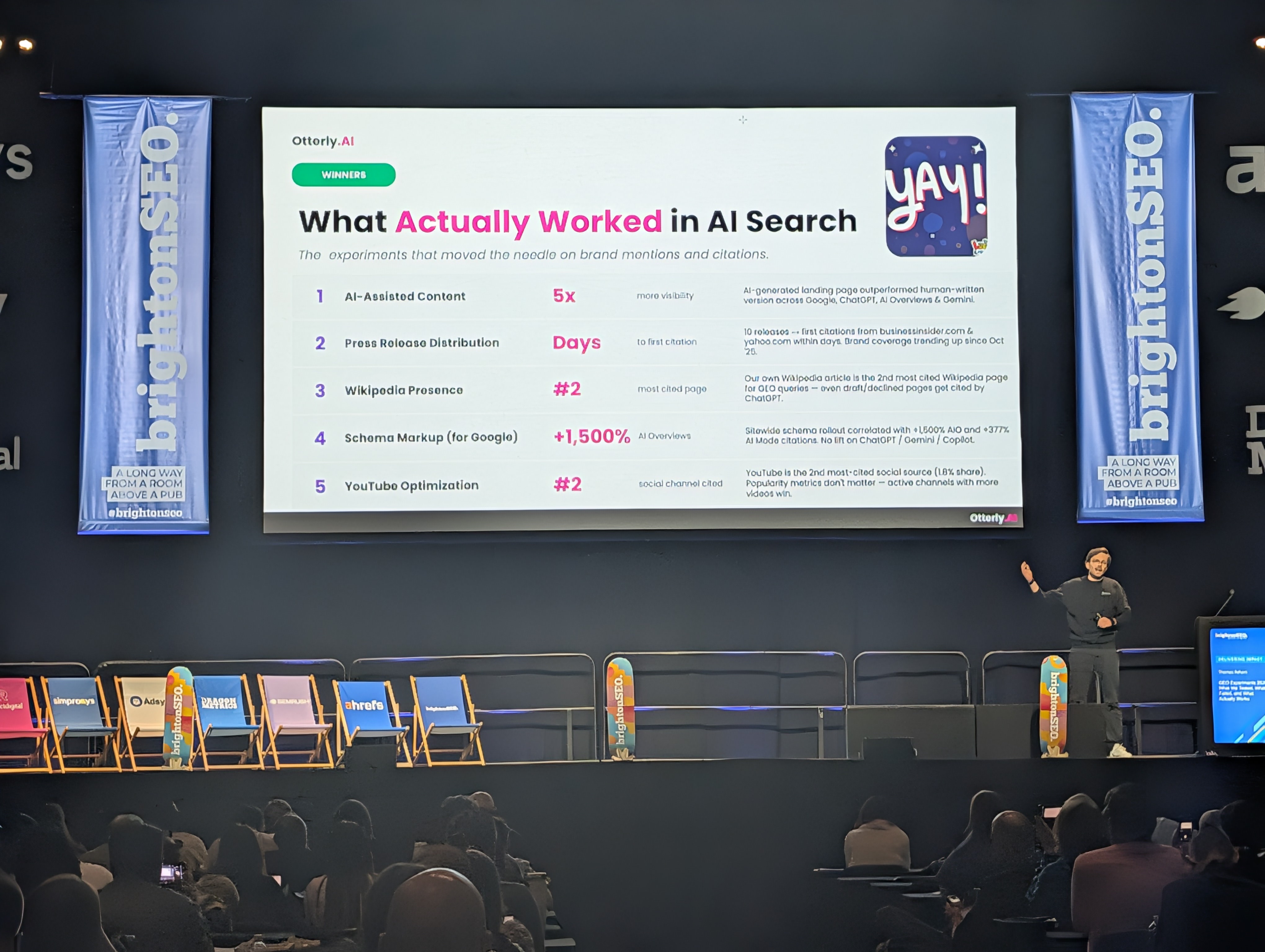
Thomas Peham’s talk, GEO Experiments 2026: What We Tested, What Failed, and What Actually Works, was particularly useful because it moved beyond theory and into experiments. His session covered what had and had not worked across areas such as llms.txt, schema, HTML versus markdown, YouTube authority, press releases, localisation, and AI crawler behaviour.
Some experiments suggested schema helped in certain environments but not in others. Some suggested llms.txt had limited impact. Some showed that HTML was more likely to be cited than markdown. Other talks reinforced the role of YouTube authority, brand mentions, digital PR, third-party validation, localisation, and clear technical foundations.
Janaina Barreto-Romero’s talk, AI search reality check: Making sense of change with imperfect signals, also landed well. The point about technical debt becoming more serious in AI search was important. Technical issues no longer only risk lost rankings. They may also mean missed citations, weak retrieval, and poor machine interpretation.
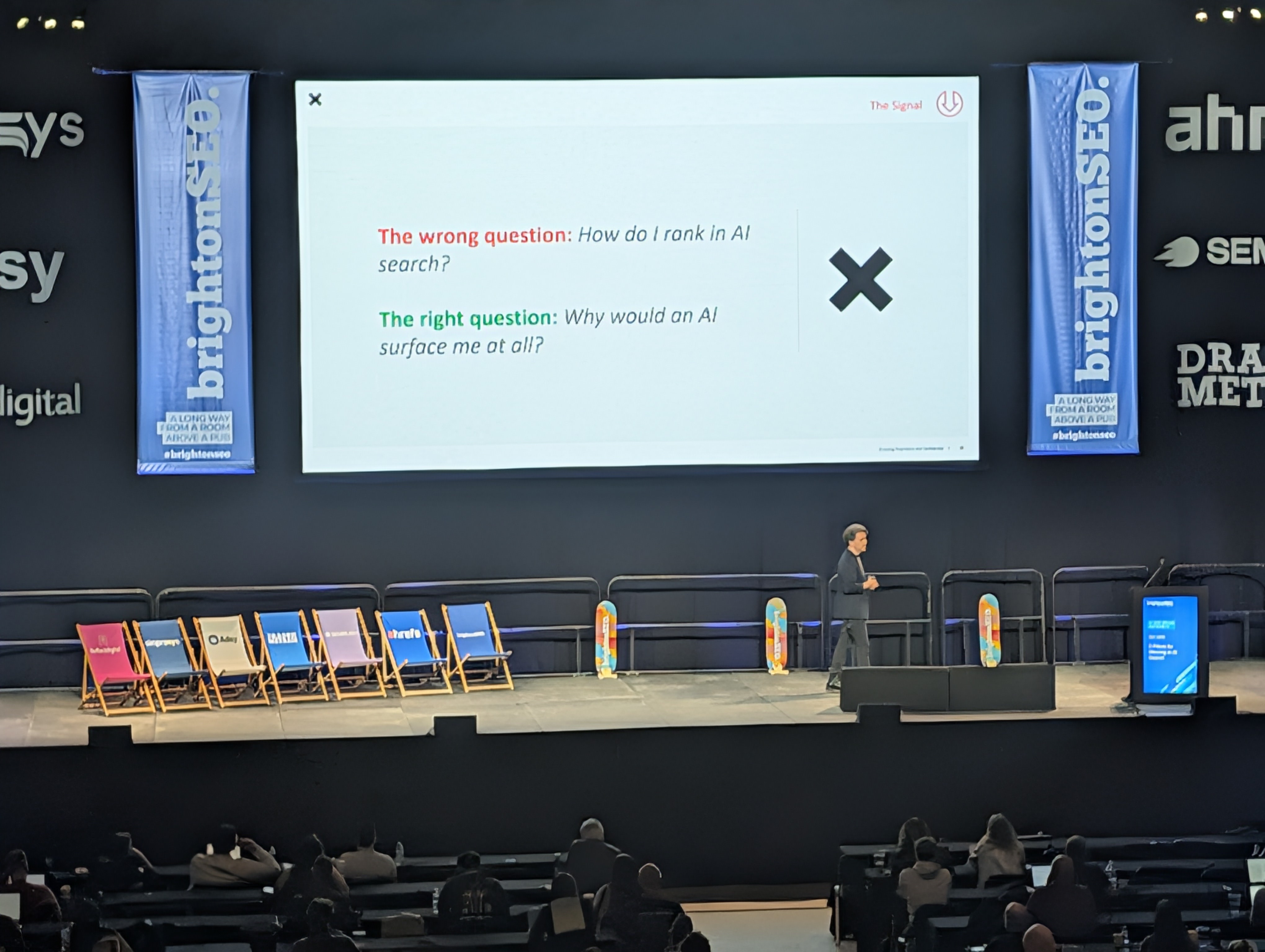
Dan Liddle then built on this with his talk, 5 Pillars for Winning in AI Search. His framing was the right one: the better question is not simply, “How do I get cited in AI search?” It is, “Why would AI search cite this brand at all?”
That reframes AI search completely.
AI visibility is not a single tactic. It is the result of a wider set of signals that make a brand easier to understand, trust, retrieve, and cite.
That includes:
- Technically accessible content
- Clear information architecture
- Well-structured pages
- Strong internal linking
- Useful, specific content
- Third-party mentions
- Reviews and reputation
- Brand consistency
- Accurate entity information
- Clean product and service data
- Credible external citations
The question is not, “How do I trick AI systems into mentioning a brand?”
The better question is:
Why would an AI system trust, understand, and recommend this brand in the first place?
AI search is not separate from SEO. It is not a bolt-on. It is a natural extension of good search, brand, content, technical, and authority work. That matters because the brands most likely to adapt are not always the ones chasing the newest tactic first. They are often the ones with cleaner foundations, clearer positioning, better content, stronger reputation signals, and fewer technical loose ends.
Brand discoverability now has to happen everywhere
One of the strongest cultural shifts from the event was the recognition that brands cannot afford to think only in terms of traditional search anymore.
Google still matters enormously. Tom Capper made that clear in his talk on organic visibility. It remains the dominant search platform for many users and many commercial journeys.
But discovery is now happening across a wider set of platforms and spaces.
Phil Clark’s talk, Turning Search Data into Work that Delivers, made a strong case for moving beyond traditional keyword analysis. His line that the search bar is “the gateway to behaviour” captures where search strategy needs to go. People are not only typing neat phrases into Google. They are showing intent, frustration, demand, and category opportunity across search data, Reddit, TikTok, YouTube, reviews, sales conversations, and product feedback.
Ainhoa Lizarralde’s talk, Defining your content North Star in a zero-click world, reinforced the importance of understanding user-generated content and community-led conversations. Reddit, in particular, came up repeatedly across the event as a place where intent, sentiment, questions, and trust signals can be seen more clearly.
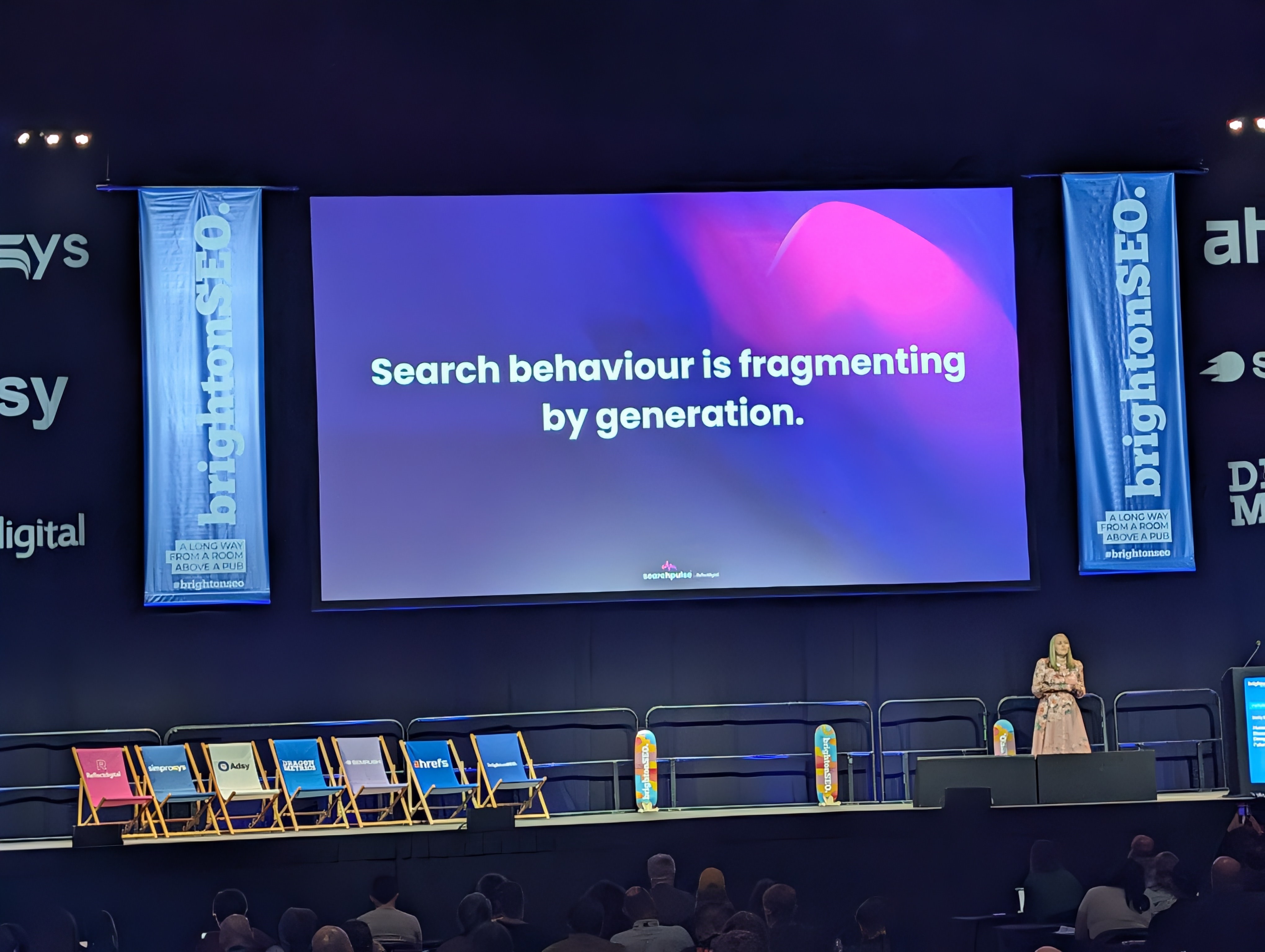
People are using Google, AI Overviews, ChatGPT, Gemini, Perplexity, TikTok, Reddit, YouTube, review platforms, comparison sites, social feeds, marketplaces, and community-led conversations to research and choose brands.
That means search strategy has to broaden.
This is not about creating separate, disconnected strategies for SEO, AI search, PPC, content, social, and digital PR. It is about understanding how each area contributes to discoverability, trust, and conversion. In agency life, the biggest gains often come when those teams stop optimising their own small corner and start looking at the full customer journey together.
The more fragmented discovery becomes, the more important it is to have one unified search and visibility strategy.
For me, this is where SEO and AI search should be positioned together, not as competing disciplines.
Traditional search and AI-driven discovery are part of the same broader challenge:
Can your brand be found, understood, trusted, and chosen wherever people are researching?
Originality and trust matter more when everyone can create content
Another recurring theme was quality.
In a world where everyone has access to AI tools, the bar changes.
If every brand can generate acceptable content quickly, then acceptable content becomes less valuable. The differentiators become originality, accuracy, credibility, experience, usefulness, and trust.
Jon Earshaw’s talk, From Clicks to Conversations: Preparing for Zero-Click Search in an Agent-Driven World, made this especially clear. One of the notes I wrote down was that generic content collapses and loses its identity. That is exactly the risk for brands producing content simply because AI makes it easier to do so.
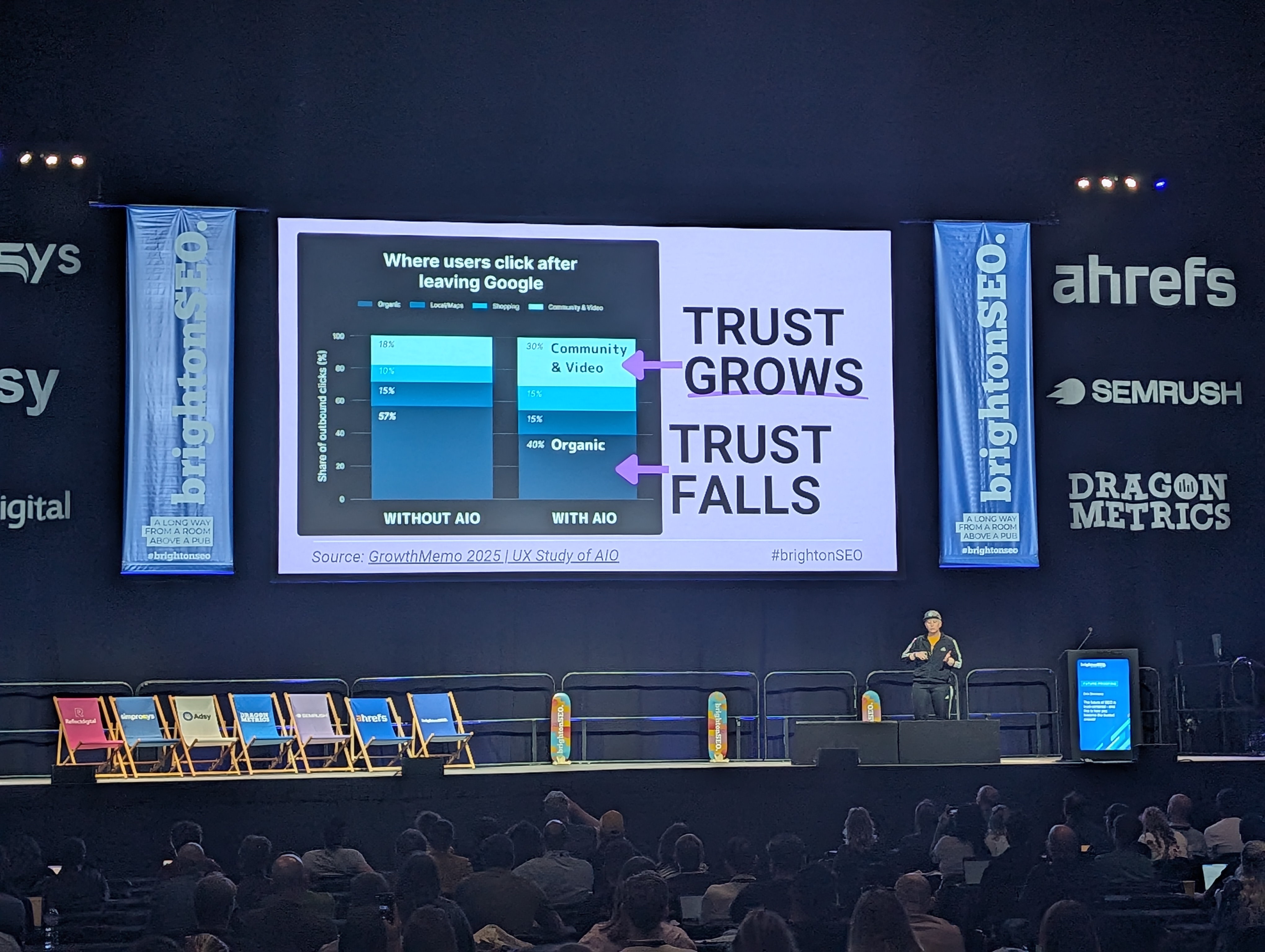
Erin Simmons then brought trust into sharper focus with her talk, The future of SEO is trust-centered, and this is how you become the trusted answer. Her framing of search as a trust experience from start to finish felt like one of the most important themes of the event.
That brings E-E-A-T back into sharper focus, not as a box-ticking SEO acronym, but as a practical framework for making a brand more credible and harder to ignore.
The content most likely to stand out is content that includes:
- Original insight
- Real experience
- Clear expertise
- Specific examples
- Strong opinions where appropriate
- Useful detail
- Human judgement
- Third-party validation
- Accurate and well-maintained information
Generic content collapses into the noise.
This is especially important for AI-driven search. If AI systems are summarising, citing, comparing, and recommending brands, they need signals that help them decide which sources are credible.
That credibility cannot be faked with a few prompts or surface-level optimisation.
It has to be built. And in my experience, the brands that build it properly are usually the ones willing to put real knowledge into their content, show the people behind the expertise, maintain accuracy over time, and say something more useful than the category average.
Digital PR and third-party validation are becoming harder to ignore
A recurring theme across multiple talks was the importance of external validation.
Haider Ali’s talk, The Organic Discoverability Framework: Connecting SEO, GEO, Content & PR, set the tone for the connection between digital PR, organic discoverability, and AI visibility that came up again and again afterwards.
Thomas Peham’s GEO experiments also pointed towards the impact of press releases and external brand mentions on AI citations. Jack Lingard’s zero-click SEO talk made a similar point from a measurement perspective, particularly around the role of third-party sources in AI-led discovery.
If AI systems are drawing from the wider web, a brand website is only one part of the picture. Third-party sources, reviews, press coverage, Reddit discussions, YouTube content, forums, comparison sites, and community conversations all shape how a brand is interpreted.
This matters because AI search often reflects what the wider web says about a business, not just what the business says about itself.
That creates both risk and opportunity.
The risk is that outdated, inaccurate, negative, or incomplete information can be surfaced and repeated. Janaina Barreto-Romero’s AI search reality check included a useful example around older negative information being surfaced in AI-generated responses. For brands in sensitive sectors, this can become a serious reputation and trust issue.
The opportunity is that strong digital PR, useful brand mentions, expert commentary, and third-party validation can help shape how a brand is understood across search and AI-driven platforms.
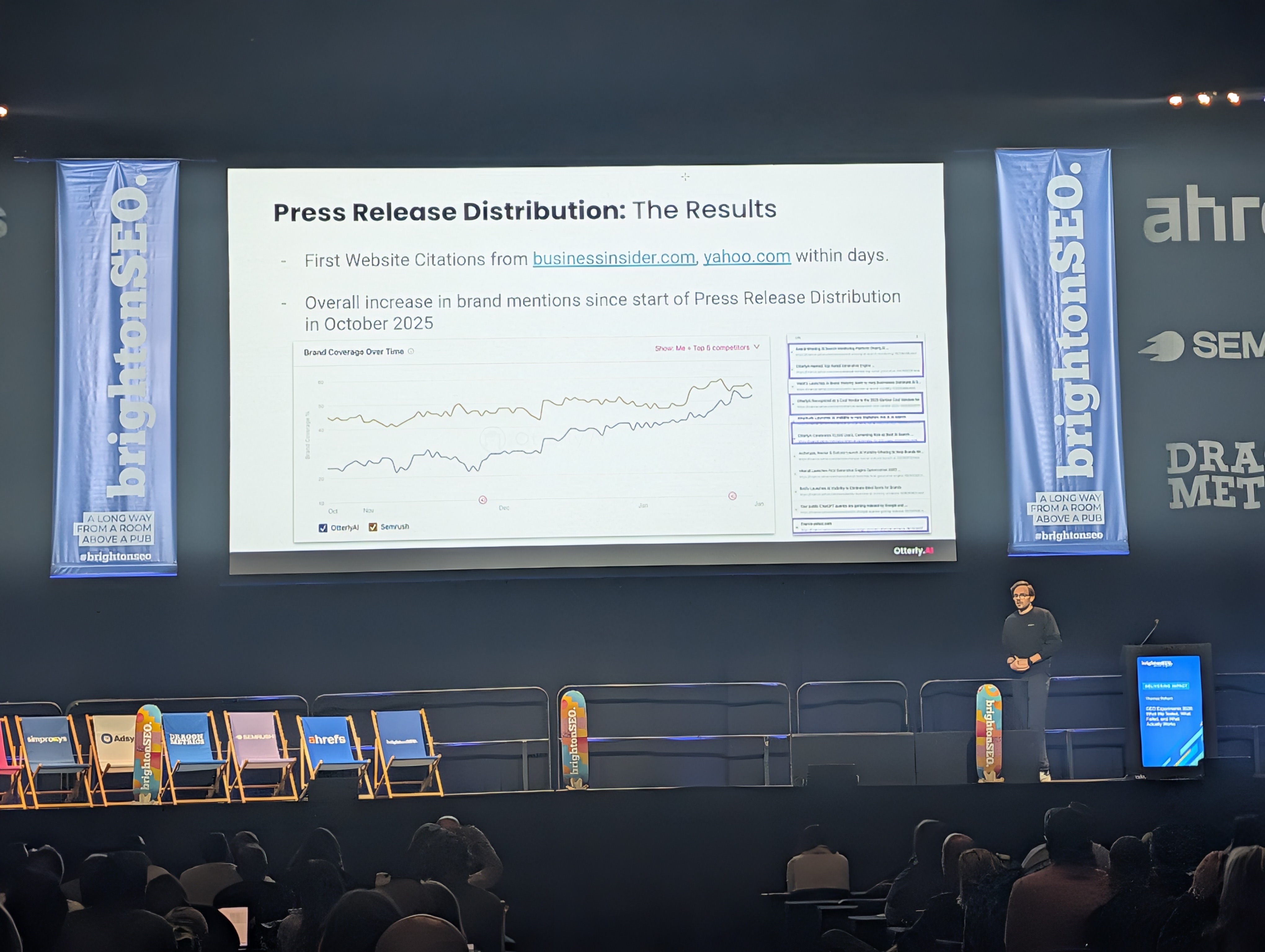
This makes PR more commercially relevant to search than it has been in the past. I would not frame that as link building with a new label. It is broader than that. It is about giving search engines, AI systems, journalists, communities, prospects, and customers more credible reasons to associate a brand with the right topics.
For businesses that want to improve AI visibility, digital PR should not be treated as a separate awareness activity. It should be part of the search strategy.
Search is moving from keywords to conversations
Another repeated theme was the shift from keywords to problems, conversations, and prompts.
That does not mean keyword research is dead. It means keyword research on its own is too narrow.
Phil Clark’s Turning Search Data into Work that Delivers made this point from a demand and category perspective. Jon Earshaw’s From Clicks to Conversations made it from an AI and agentic search perspective. Pablo López’s talk, AI-Aware Citations: Researching and Mapping Brand Mentions, made it from a prompt and citation-mapping perspective.
Different talks, same direction of travel.
People do not always search in neat, high-volume phrases. They describe problems. They ask layered questions. They compare options. They add context. They use TikTok, Reddit, YouTube, Google, ChatGPT, Gemini, Perplexity, and other platforms differently depending on their age, intent, confidence, and stage of decision-making.
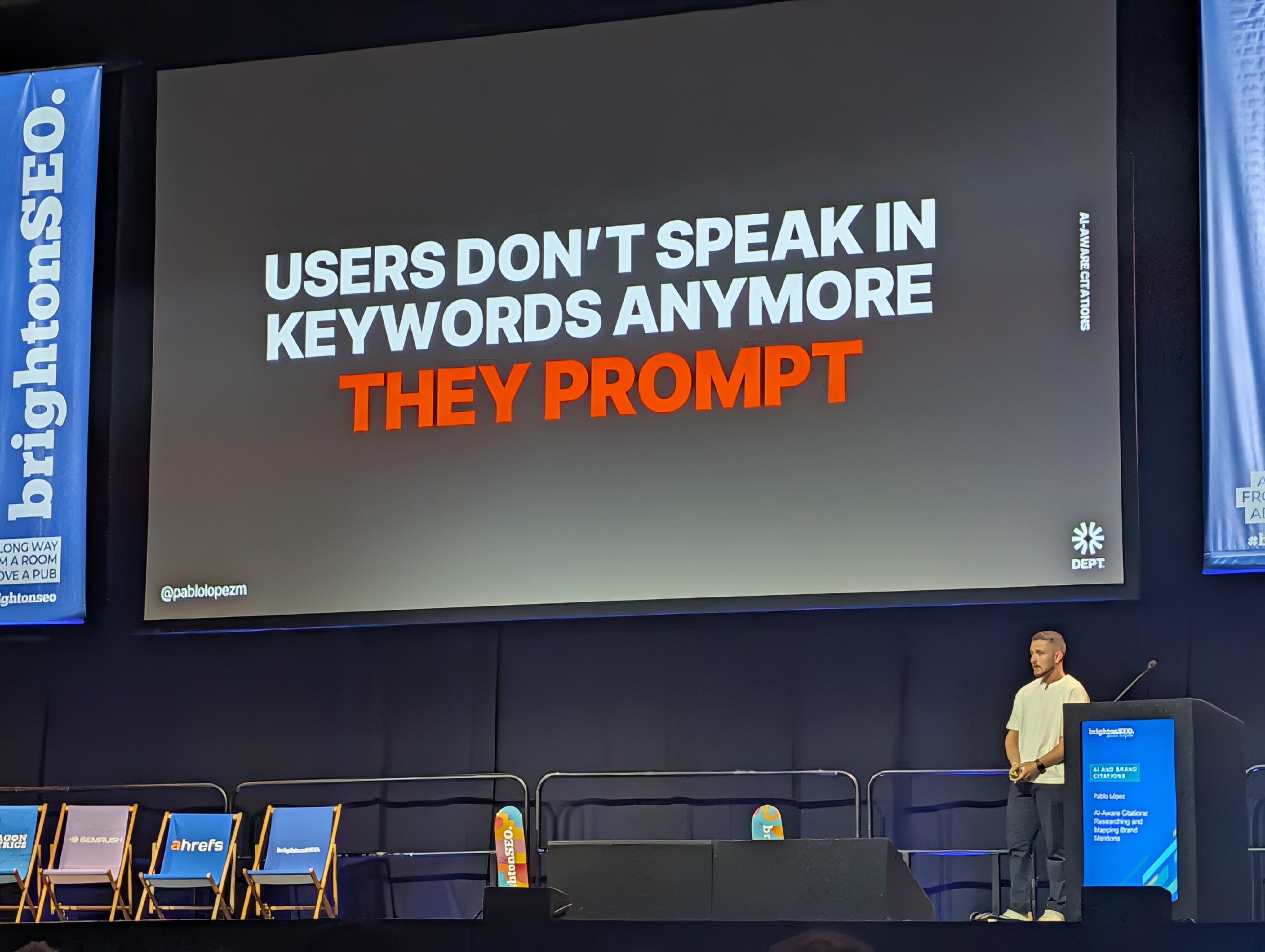
This has a direct impact on content strategy.
A keyword-led approach might ask:
“What phrases should this brand rank for?”
A better approach asks:
“What problems are people trying to solve, and where are those conversations already happening?”
That means analysing:
- Search queries
- Customer reviews
- Sales calls
- Reddit threads
- TikTok behaviour
- YouTube comments
- Internal site search
- Customer service questions
- Competitor positioning
- AI-generated recommendations
- Product and service objections
This is where search becomes much more useful commercially.
The strongest opportunities often sit where customer pain, category demand, and brand relevance overlap. That is where content can influence real buying decisions, not just chase impressions. After years of seeing keyword-led content plans underperform commercially, this point feels especially important. Volume is useful, but it is not the same thing as opportunity.
Paid and organic need to work under one strategy
Another clear takeaway was that paid and organic search cannot operate in silos.
Tom Capper’s How low can organic go made the organic visibility challenge clear. Ashley Fletcher’s talk, Google AI Overviews: Paid Search Impact and Protecting Visibility, brought the paid search angle into the same conversation.
Commercial SERPs are increasingly crowded. AI Overviews may dominate informational results. Paid ads and product features may dominate commercial ones. Organic rankings may still be valuable, but the level of actual visibility can vary dramatically by device, vertical, and result type.
That means brands need to understand how SEO and PPC work together on the same search landscape.
For some priority searches, paid may be needed to secure above-the-fold visibility while organic supports trust and consideration. For others, organic content may shape demand earlier in the journey before paid search captures high-intent conversion. For ecommerce brands, feed optimisation, Merchant Center attributes, product data, reviews, and landing page quality may be just as important as campaign structure.
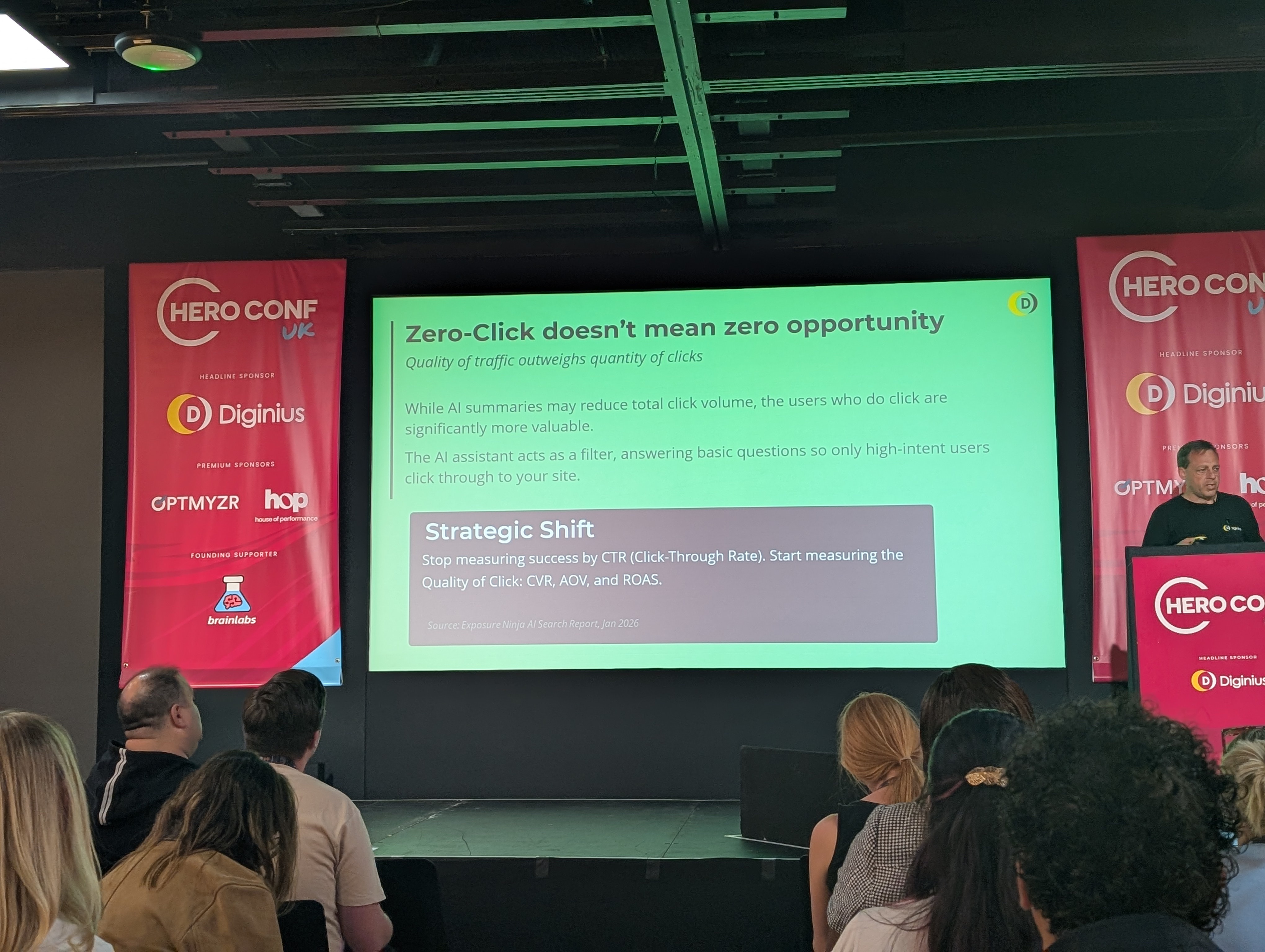
Nate Burke’s talk, Beyond the Feed: Breakthrough Ad Innovations Across Microsoft, TikTok & Programmatic ABM, reinforced the same broader point. Zero-click does not mean zero opportunity. Quality of traffic, platform fit, audience behaviour, and post-click experience matter more than a simple click count.
The commercial question is not, “Should this be SEO or PPC?”
The better question is:
What combination of search activity gives the strongest visibility, trust, and conversion opportunity for this intent?
That is where the best growth will come from.
Paid media has the same problem as SEO: weak measurement
HeroConf reinforced something I already believe strongly.
Paid media performance is only as good as the data being fed back into the platforms.
Two talks were especially relevant here. Baris Asa’s Where Did My Paid Clicks Go? Five Post-Click Leaks You Can Plug with Cloudflare and Michael Wisby’s Server-Side Tracking: The Unsexy Foundation Saving Your ROAS both focused on what happens beneath the surface of paid media performance.
There was a lot of useful discussion around server-side tracking, conversion signal loss, bot traffic, ad blockers, consent mode, attribution gaps, broken deduplication, page speed, redirects, and poor quality conversion data.
The message was blunt. Smart bidding is only smart if the conversion signals are clean.
If Google Ads, Meta, LinkedIn, TikTok, or Microsoft Ads are optimising towards incomplete, duplicated, low-quality, or spam-heavy conversion data, then performance will suffer. The issue may not be the ad copy, the creative, the campaign structure, or the bidding strategy. The issue may be the infrastructure beneath it.
That is an important point for both agencies and clients.
Too much paid media discussion still happens at the surface level:
- More budget
- New creative
- Different audiences
- New campaign types
- Fresh ad copy
- Bid strategy changes
All of that can matter. But if tracking is broken, form submissions are full of junk, server-side tracking is missing, page speed is poor, and conversion quality is not being passed back properly, then the account is being optimised on weak foundations.
That is where SEO, PPC, CRO, analytics, and development need to work together.
The best performance gains often come from fixing the system, not just changing the campaign. I have seen this play out repeatedly: the issue looks like media performance on the surface, but the real leak is tracking, form quality, landing page speed, consent setup, or weak lead qualification.
Reporting needs to start with better questions
One of the most practical themes from the event was reporting.
Katie New’s talk, Nobody reads your reports (and this is how you fix it!), was particularly useful here.
The point that stood out was simple:
Stop starting with the metrics. Start with the question.
Too many reports answer vague questions such as, “How is the site performing?” That usually leads to a collection of disconnected charts, channel snapshots, ranking tables, traffic lines, and commentary that does not drive better decisions.
A better report answers a sharper question:
- Which channel is most effectively driving sales?
- Is the business losing valuable traffic or low-intent traffic?
- Which landing pages are contributing to revenue?
- Where is cost per acquisition improving or worsening?
- Are paid and organic working together on priority SERPs?
- Which products or services have rising demand?
- Which content is influencing consideration?
- Where are users dropping out before converting?
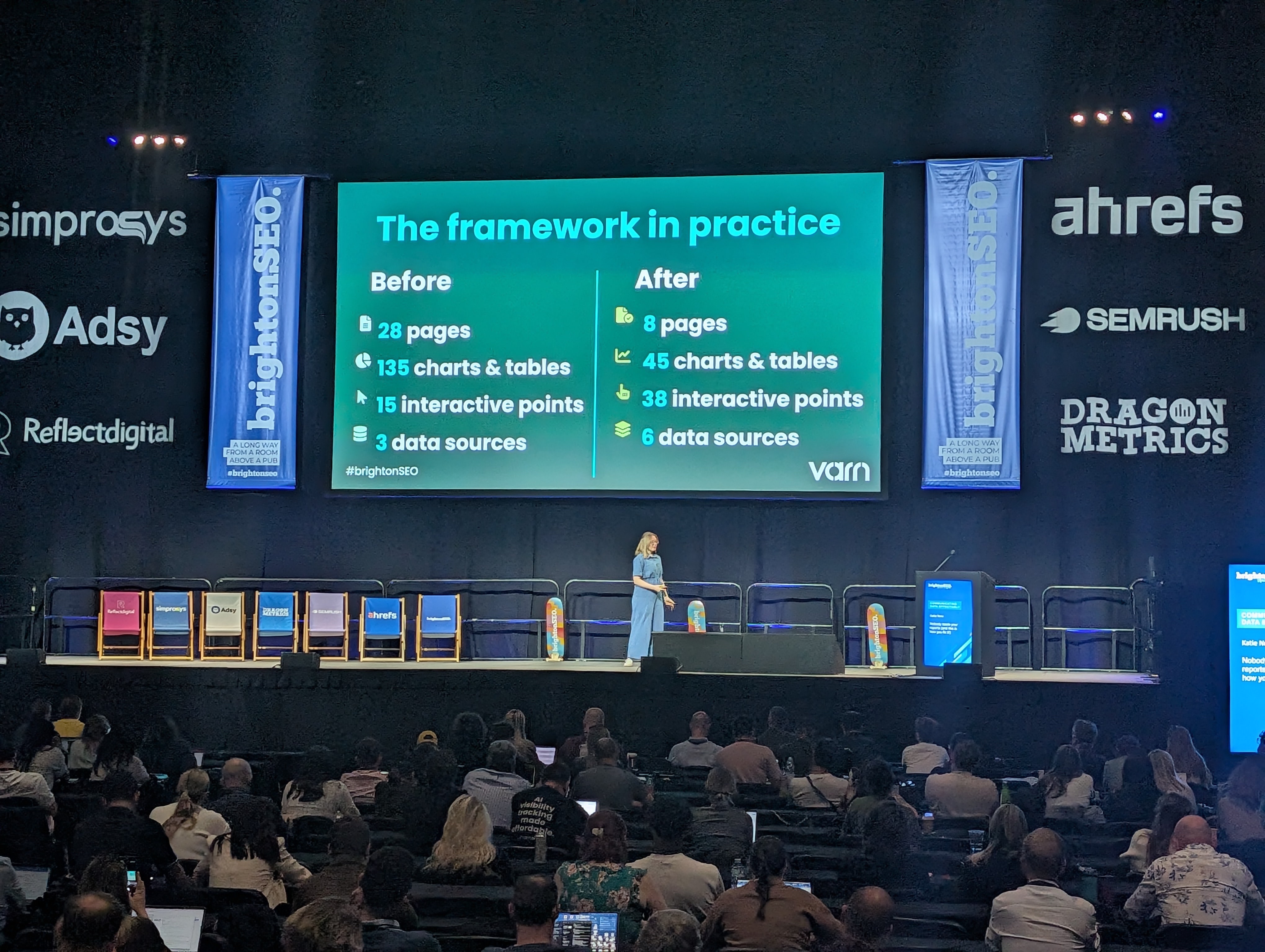
Judith Lewis’s talk in the same session, LLM visibility and AI-driven search: what replaces “rankings” as the primary KPI, added another layer to this. The money is what matters to senior teams. AI visibility, rankings, citations, and traffic all need to connect back to commercial outcomes where possible.
This matters because reporting should not exist to document activity. It should support decisions.
For senior stakeholders, that means less noise and more interpretation. Not just what happened, but why it happened, what it means commercially, and what should happen next. In my experience, this is where senior search work earns trust: not by showing every possible metric, but by helping people make better decisions from the right ones.
Stakeholder buy-in is a performance issue
Another major reflection was around stakeholder management.
This came through strongly in Jake Rudge’s talk, SEO Stakeholder Management: Improving Client Relations Through Strategic Buy-In.
The line that stuck with me was the idea that the client did not fail to implement the recommendation. The SEO failed to give them a good enough reason to.
That is uncomfortable, but useful.
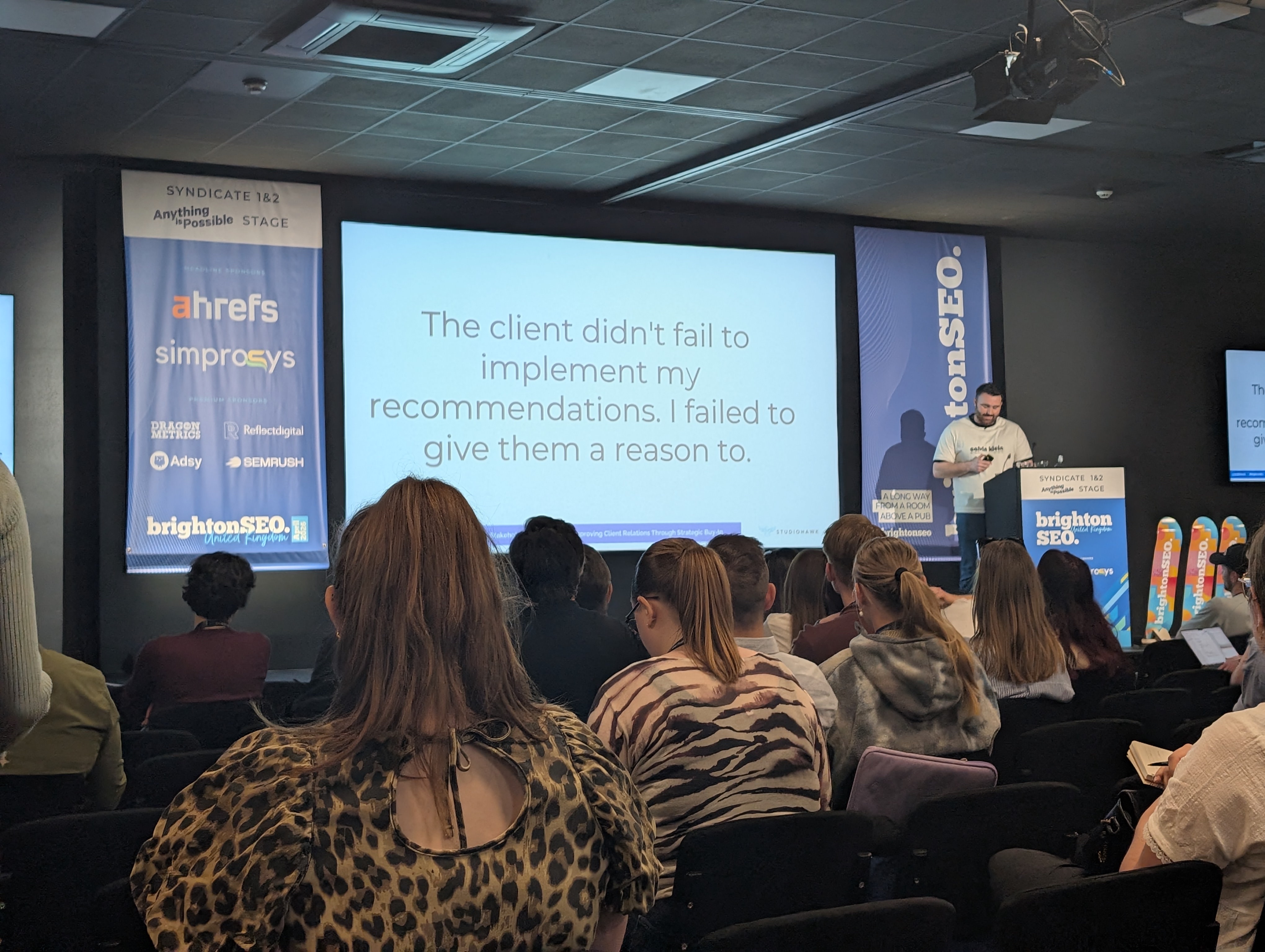
Search specialists often think the value of a recommendation is self-evident. It rarely is. After 18+ years in agency environments, I have learnt that the quality of a recommendation is only part of the job. The way it is framed, prioritised, evidenced, and followed through often determines whether it ever gets implemented.
Clients and internal stakeholders are dealing with competing priorities, limited resources, budget pressure, internal politics, development constraints, and commercial targets. If a recommendation is framed as a technical task rather than a business priority, it is easy for it to stall.
This is where senior search work needs to be more commercially literate.
A founder may care about revenue, competitive position, speed, and risk.
A Head of Growth may care about CAC, channel mix, pipeline, and efficiency.
A Head of Marketing may care about performance narrative, internal visibility, and proving progress to senior leadership.
A developer may care about complexity, dependencies, and technical risk.
The same recommendation needs to be framed differently depending on who needs to act on it.
That is not soft skills as an optional extra. It directly affects implementation, retention, performance, and revenue.
Trust is becoming the centre of search
Several talks came back to trust.
Trust in brands. Trust in sources. Trust in communities. Trust in data. Trust in reports. Trust in AI-generated answers. Trust in the recommendations machines make on behalf of people.
Erin Simmons’ talk, The future of SEO is trust-centered, Sean Barber’s Fighting Misinformation In YMYL: Lessons from Macmillan Cancer Support, and Dan Liddle’s 5 Pillars for Winning in AI Search all approached this from different angles.
That feels like the right framing for where search is heading.
If AI systems are choosing which brands to cite, recommend, compare, summarise, or ignore, then trust becomes a commercial asset. Not in a vague brand sense, but in a very practical search sense.
Trust is built through:
- Clear expertise
- Accurate content
- Visible people
- Strong reviews
- Consistent brand information
- Useful third-party mentions
- Community presence
- Original insight
- Strong technical foundations
- Reliable product and service data
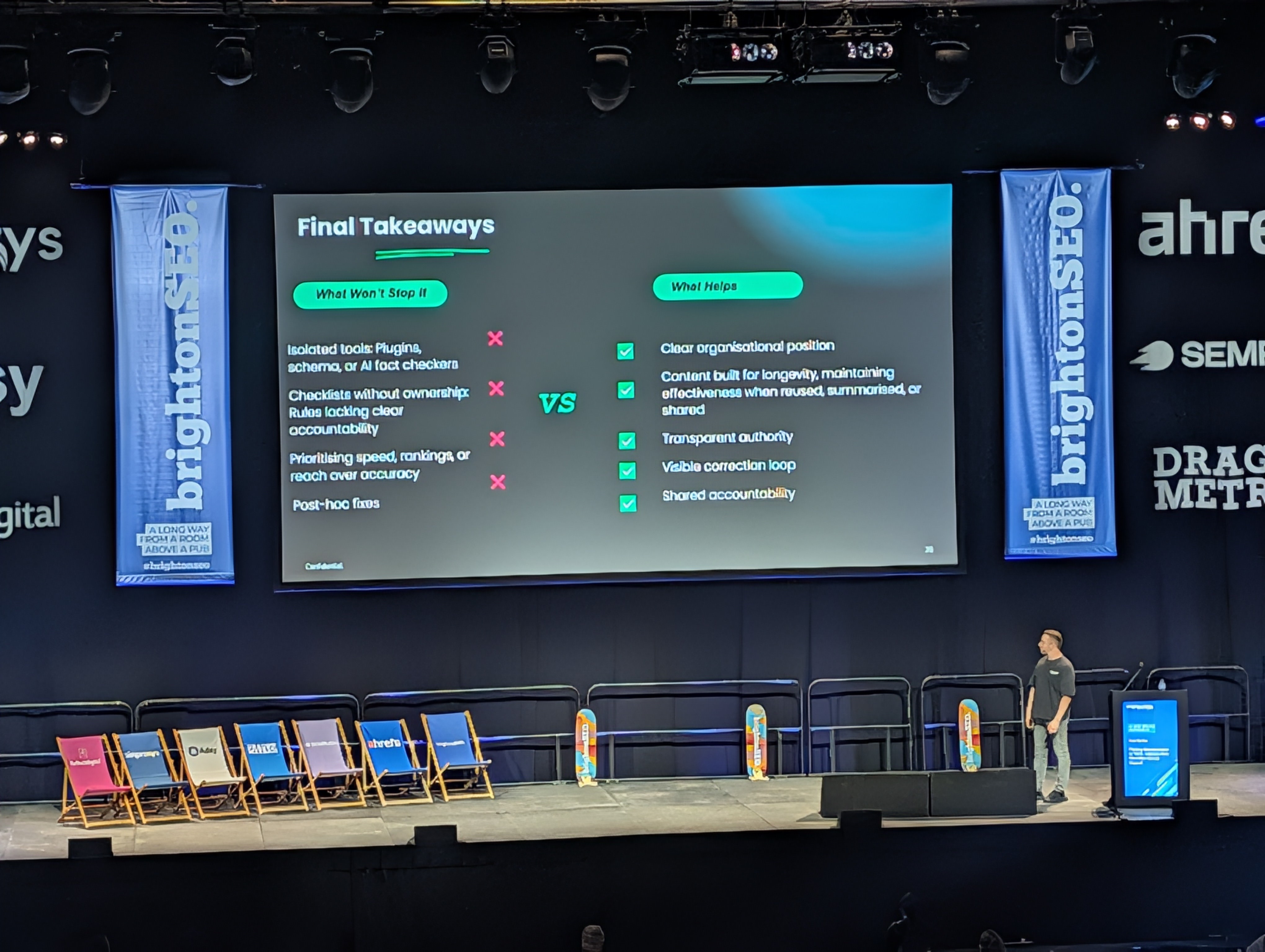
The brands that win will not just be the ones that publish the most content. They will be the ones that are easiest to understand, easiest to verify, and easiest to recommend. That is why experience, expertise, authority, and trust should not sit in a content checklist. They should show up in how the whole brand behaves online.
The search marketer role is broadening
The final reflection is about the role of the search marketer itself.
Across both brightonSEO and HeroConf, there were repeated references to new types of roles and skill sets: marketing engineer, agentic operator, technical strategist, AI search specialist, measurement lead, automation builder.
Nick Lafferty’s talk, The Rules Have Changed: What 10 Billion Citations Reveal About Winning AI Search in 2026, was one of the sessions that captured this direction of travel. So did Samanyou Garg’s talk, We Sent AI Agents to Win AI Search. Here’s What Actually Happened.
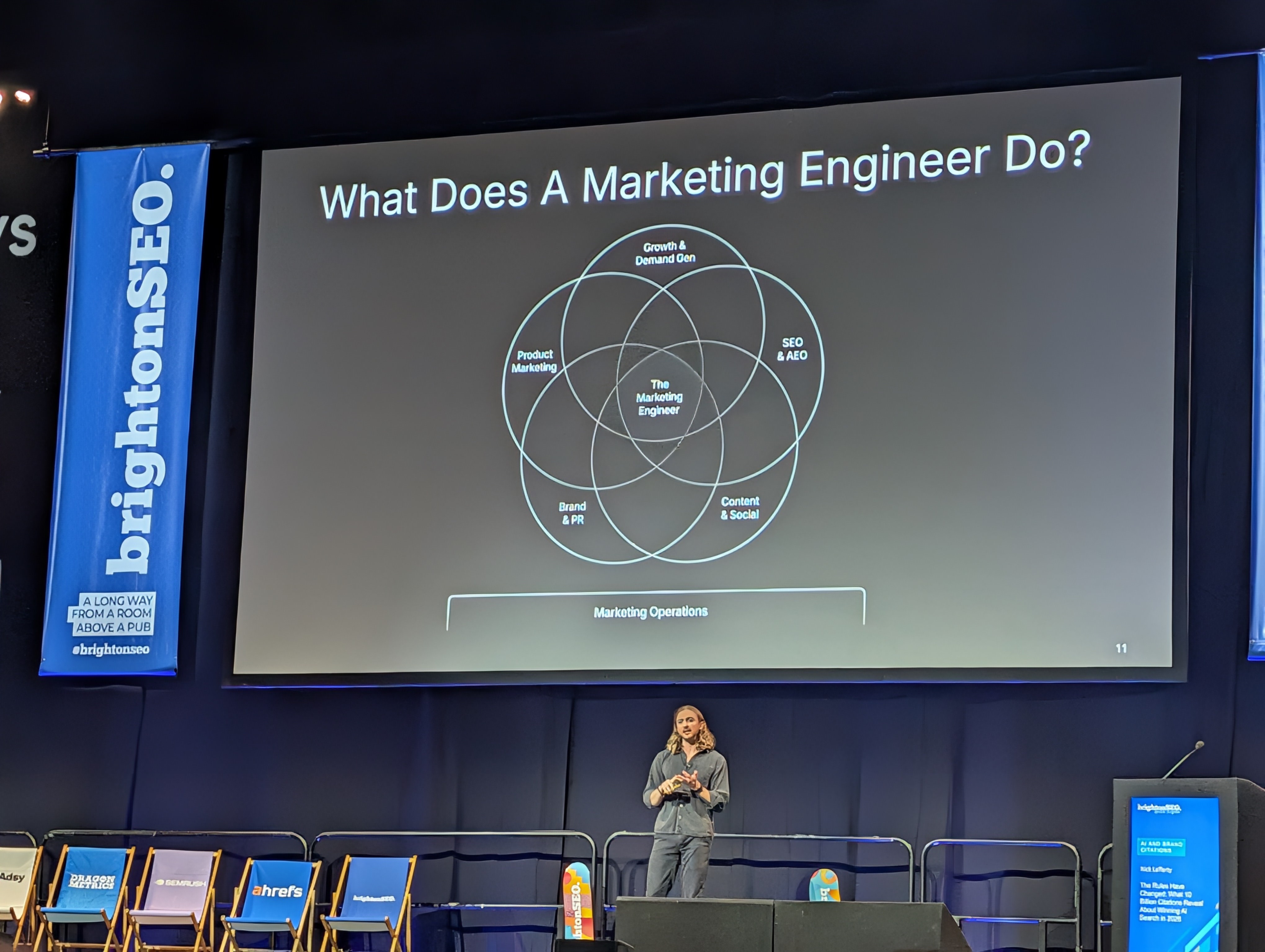
The specific titles matter less than the direction of travel.
Search marketers increasingly need to understand technical SEO, content strategy, paid media, CRO, analytics, data quality, tracking infrastructure, AI search behaviour, brand authority, digital PR, automation, stakeholder communication, and commercial strategy.
That does not mean every person has to be an expert in every discipline. But it does mean search can no longer sit in a narrow box.
The strongest search teams will be the ones that can connect the work across channels, platforms, data, content, and commercial outcomes.
Final thoughts
The strongest message I took from brightonSEO and HeroConf 2026 was not that search has been reinvented overnight.
It was that search has become harder to separate into neat little boxes.
A ranking is not always visibility. A lost click is not always a lost customer. A report is not useful just because it has a lot of charts in it. A paid media account is not healthy just because the campaigns look tidy. A brand is not trusted just because its own website says all the right things.
That is the shift.
Search now sits across visibility, reputation, data quality, content, paid media, customer behaviour, and commercial decision-making. People may discover a brand through Google, check what others are saying on Reddit, compare options in ChatGPT, watch a YouTube review, click a paid ad, return through direct traffic, and convert days or weeks later.
Messy? Yes.
Harder to measure? Absolutely.
Less valuable? I do not think so.
The work now is to build search strategies that reflect how people actually discover, evaluate, and choose brands in 2026. Not how reporting templates were built ten years ago.
That is probably why this event felt so useful. It did not make me want to throw away what I know from 18+ years in search. It made me want to apply that experience with sharper questions, better measurement, and a wider view of where trust is built.
And, most importantly, to do all of that while keeping hold of your chips from the Brighton seagulls.